
A jar that smells beautiful with the lid off can still disappoint once it’s lit. That gap is the difference between cold throw and hot throw. Cold throw is the strength of fragrance before a candle has been burned for the first time. Hot throw is the strength of fragrance while it’s burning. When soy candle hot throw is weak, there are several factors worth checking: cure time, fragrance load, temperature, wick, melt pool, container and the wax itself.
This guide works through those factors in a sensible order, so you can find the cause and know how to improve hot throw without trying hacks at random.
Judge hot throw fairly before changing anything
Before you adjust a recipe, make sure your testing gives you a fair reading.
Hot throw is typically assessed after the candle has been burning for at least two hours but no more than four. The scent comes from the melt pool, and it can take 2–3 hours of burn time for a candle to fill a room.
Settle the wick first. Complete your burn testing and finalise the wick before you judge throw, because a candle can seem to throw strongly in its early burns and later turn out to be overwicked. A room full of test candles is also a poor place to judge any one of them.
Then think about the room and the nose doing the judging:
- Room factors. High ceilings, humidity and draughts all change how hot throw comes across. Burn the candle in a few different settings.
- Different people. No two people smell the same, and if you’ve worked with one fragrance for a while, you’ll likely find it weaker than others do. That’s nose blindness. Ask a few other people for their opinion.
Finally, keep notes. Treat it like baking: measure precisely and record weights, pour temperature, the supplies you used and anything you notice. Without notes, you can’t tell which change made the difference.
Candle cure time: give soy a chance to bind
Soy wax traps fragrance oil as it bonds and takes longer to bind than some other waxes. It also doesn’t release fragrance as readily. Letting the candle cure before its first burn gives the wax and fragrance time to bind fully.
As a starting point, soy and other natural waxes should cure for at least 1–2 weeks. Treat that as a minimum rather than a fixed rule. Cure times for soy vary, so the way to find what your candle needs for its best hot throw is to test it.
One simple approach is to pour several candles from the same batch and light them at different points along the cure, judging each with the fair-testing method above. Over a few batches you’ll learn how long your combination of wax, fragrance and container wants.
Fragrance load for soy wax, temperature and stirring
More isn’t always stronger
When a candle isn’t throwing scent, the obvious move is to add more fragrance. It often doesn’t work, and it can have the opposite effect.
Most high-quality fragrance oils are quite strong at 6–8%, and using a wax’s maximum load is rarely necessary. Candles overloaded with fragrance oil don’t burn as well, so they don’t throw as well either. Dense fragrances in particular can cause burn issues when used heavily.
A better starting point is 1–2% below your wax’s maximum fragrance load, adjusting from there. If the maximum is 10%, start at 8%. Every wax has its own maximum fragrance load, cure time and suggested wick series, so get to know the usage instructions for your wax before you build a recipe around it.
A few related checks:
- Look for sweating. Liquid on the surface of a cooled candle (also called leaching or seeping) is typically caused by too much fragrance oil, or by adding fragrance when the wax is too cool. Either way, the fragrance hasn’t bound fully with the wax.
- Weigh everything. Candle formulas work by weight. Weigh wax and fragrance on a scale, and avoid measuring cups, spoons and the fluid-ounce setting on scales, which all measure volume.
- Use candle fragrances only. Choose fragrances developed and approved for candle use. Perfumes and colognes can contain flammable ingredients such as alcohol.
- Count any added oils. Wax can only hold so much oil. Extra oils such as coconut oil count towards your fragrance percentage and may reduce how much fragrance you can use.
Add fragrance at the right temperature
Fragrance oil needs to bind properly with the wax to throw. Adding it at 85°C (185°F) is hot enough for it to fully bind without losing fragrance to heat. With particularly dense fragrance oils, taking the wax up to about 88°C (190°F) before adding fragrance can help.
Don’t go much further. Heating soy wax above about 93°C (200°F) can make it yellow, so melt it in a double boiler or a temperature-controlled melter.
Once the fragrance is in, stir gently and continuously for two minutes. Give it another gentle stir right before pouring, especially if the wax has been sitting while it cools to pouring temperature.
Wick, melt pool and the soy candle hot throw
A lit candle releases its aroma as fragrance evaporates from the hot wax pool and from the solid candle itself. So the melt pool matters a great deal, and the wick controls the melt pool.
The wick acts like a fuel pump, drawing liquefied wax up into the flame. Different wick sizes draw different amounts of fuel. With too much, the flame flares and soots. With too little, it sputters out. Wax type, candle size and shape, colour and fragrance all affect which wick is right, which is why a wick that suits one recipe may not suit the next.
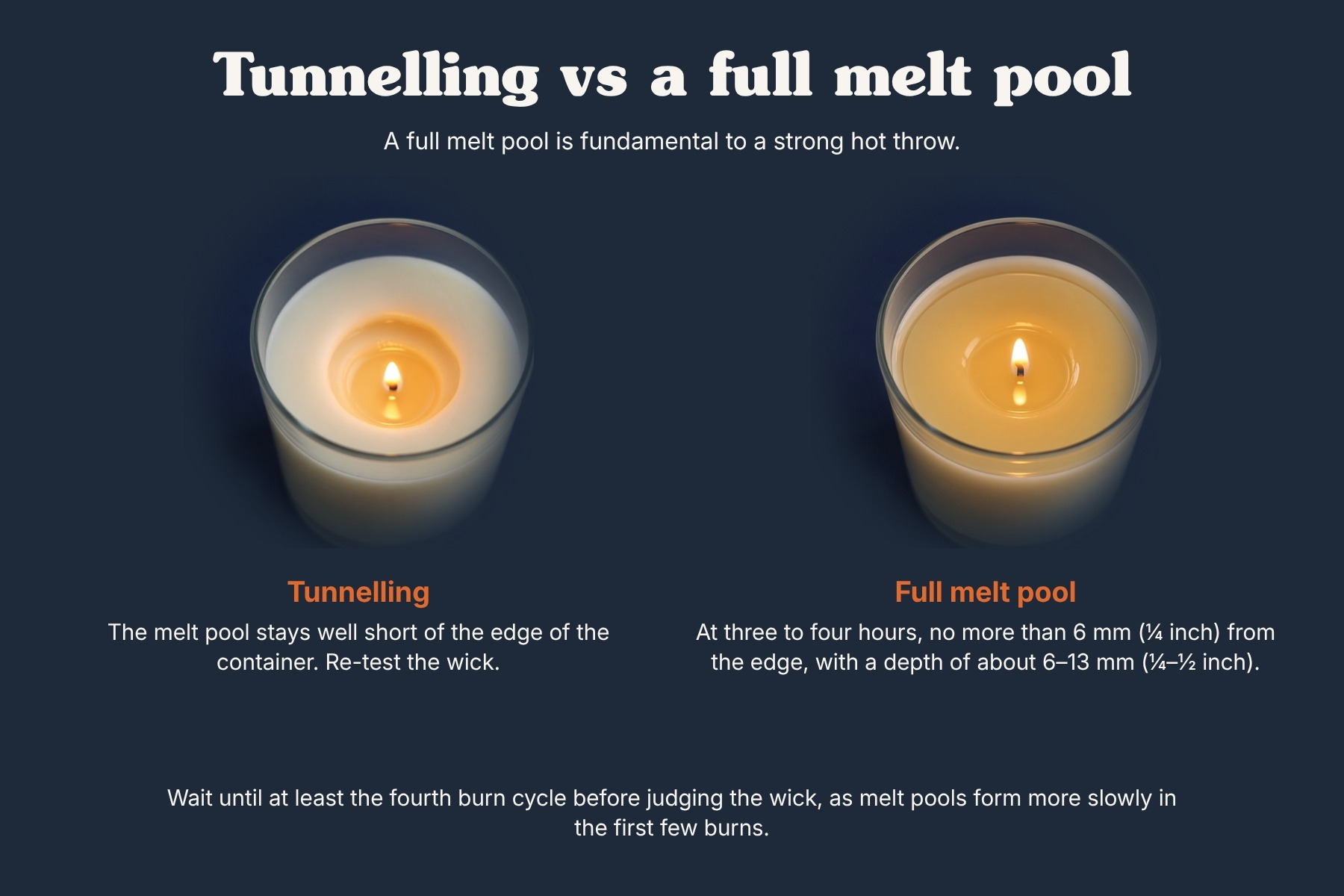
A full melt pool is fundamental to a strong hot throw. During burn testing:
- Trim the wick to 6 mm (¼ inch) before lighting.
- At three to four hours, check that the melt pool is no more than 6 mm (¼ inch) from the edge of the container, with a depth of about 6–13 mm (¼–½ inch).
- Extinguish after four hours.
- Wait until at least the fourth burn cycle before judging the wick, as melt pools form more slowly in the first few burns.
Watch the flame too. Most flames are about 2.5 cm (an inch) tall, and up to 5 cm (two inches) can be normal. Frequent large plumes of soot, or heavy soot on the container, may mean the wick should be sized down. Excess soot can also come from too high a fragrance load, so consider both.
Re-test whenever any component changes, including the fragrance. The same wax, container and wick can burn well with one fragrance at a given load and poorly with another at the same load.
Container size and the room
The larger the melt pool, the stronger the hot throw, and wider containers allow larger melt pools. If other changes haven’t helped, testing a wider container can.
Check your expectations as well. A very small-diameter candle is unlikely to fill a large room with strong scent. Decide what space a candle is meant for, and test it in a room of that size.
When the wax is the variable
Soy has a higher melting point, so it takes a lot of heat to burn and doesn’t release fragrance as readily as some other waxes. A strong hot throw with soy is achievable, but it may take more testing, wider containers and some experience.
If you’ve worked through everything above and still want more from your candles, the wax is a fair thing to test next. We make BW 200 Performance Soy Wax as the solution for makers who need a higher performing wax. It’s naturally enhanced to give the smoothest finish of our soy waxes, along with great glass adhesion and superior scent throw. It can be used as a one-pour wax, and it contains absolutely no paraffins, mineral oils or petroleum-based chemicals. Like all Barton waxes, it’s Australian Made.
No wax replaces good testing. Treat a new wax as a new variable and run it through the same burn test and throw test as everything else. You can compare it with the rest of our natural candle waxes to see which suit your range.
Soy candle hot throw checklist
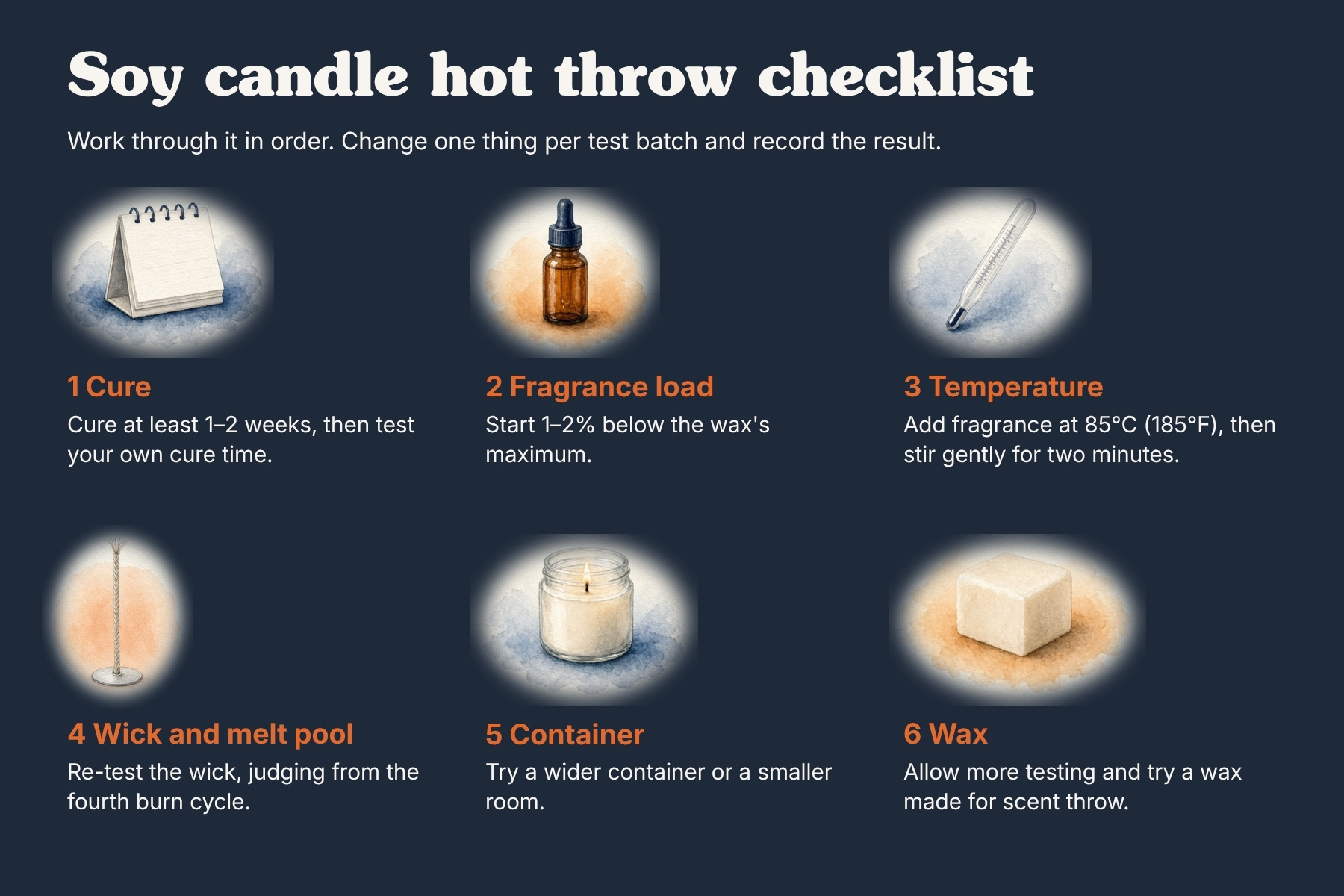
Use this table to work through common candle hot throw problems in order. Change one thing per test batch and record the result.
| Symptom | Check | What to try |
|---|---|---|
| Weak in early tests | Timing, wick, nose blindness | Assess at two to four hours, finalise the wick, ask others, try other rooms |
| Strong unlit, weak lit | Cure time | Cure at least 1–2 weeks, then test your own cure time |
| Weak despite a high load | Overloading | Start 1–2% below the wax’s maximum |
| Liquid on the cooled surface | Load, or fragrance added too cool | Reduce the load, add fragrance at 85°C (185°F) |
| Results vary between batches | Whether you’re weighing or measuring by volume | Weigh everything and keep notes |
| Dense fragrance throws poorly | Binding | Add at up to about 88°C (190°F), stir two minutes and before pouring |
| Melt pool well short of the edge | Wick sizing | Re-test the wick, judging from the fourth burn cycle |
| Large flame or heavy soot | Wick size, fragrance load | Size the wick down or reduce the load |
| Weaker after a recipe change | The changed component | Re-run the burn test |
| Small candle, big room | Container width, expectations | Try a wider container or a smaller room |
| Still modest after all of this | The wax | Allow more testing and try a wax made for scent throw |
Getting Barton wax into your own testing
If wax is now the next variable on your list and you buy your supplies from a local candle supply store, ask your local supply store to stock Barton. Once you can get BW 200, pour it alongside your current wax, run both through the same burn test and throw test, and compare your notes. Change nothing else between the two, so the wax is the only difference you’re measuring.
